Ph.D. · Protocol Engineer · Educator
James Aman
I build systems that get machines to agree without trusting each other: consensus, cryptography, and the infrastructure underneath.
I came to this from physics, and the lab left me with an instinct that transferred cleanly: measure carefully, stay with the hard problem, and don't fool yourself about what's really working. For most of the last decade I've aimed that at blockchain, designing consensus protocols, building the cryptography they lean on, and shipping the software on top. For four of those years I also taught the subject at Rice.
Minneapolis–St. Paul, MN
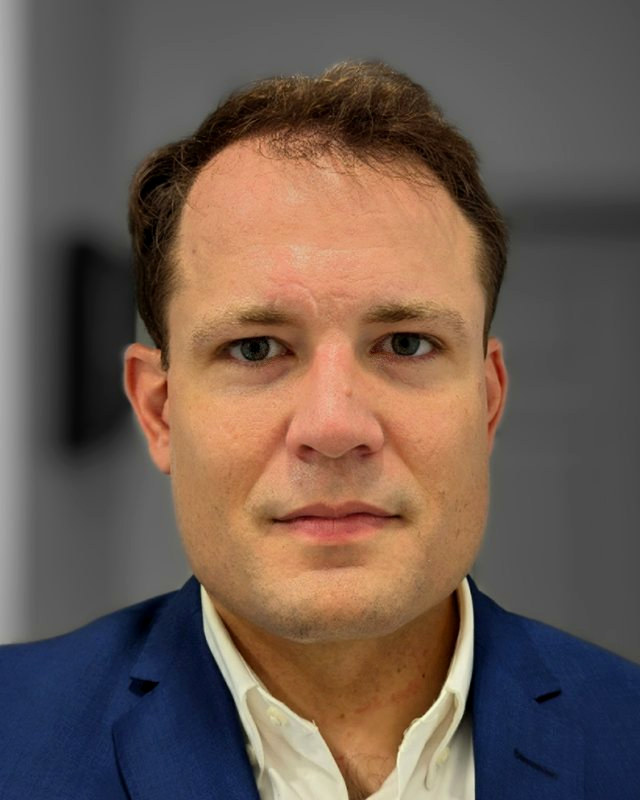
About
How a physicist ended up building blockchains.
It started in 2015, with a simple itch: how does a blockchain actually work, underneath all the noise? Chasing that question, I've built decentralized applications across a range of networks and helped design protocols, including a regularized Nakamoto proof-of-stake consensus.
At Constellation Network, I build infrastructure for systems that need strong security, careful coordination, and clear boundaries about who can do what. Before that, as co-founder of Topl, I led the engineering and research for a layer-one protocol meant to support sustainable and inclusive communities, and taught an introductory blockchain course at Rice University along the way.
Before any of that, I was a physicist. My Ph.D., finished in 2019, was about ultracold atomic gases: exotic halo molecules coaxed into existence by laser-cooling strontium. The measurements were finicky and the problems were stubborn, which was most of the appeal. More than any single result, that's where I learned how to learn, and it has turned out to be the most useful thing I own for the tangled, interconnected machinery of protocol design.
- Now
- Protocol Engineer, Constellation Network
- Focus
- Consensus, cryptography & distributed systems
- Tooling
- Scala (Cats Effect, fs2, tagless final), Rust, WASM, TypeScript
- Education
- Ph.D., Atomic, Molecular & Optical Physics, Rice University
- Based in
- Minneapolis–St. Paul, MN
Currently digging into
Current Focus
Building trust for autonomous agents.
Lately I've been chewing on a newer problem: what does an autonomous agent need in order to act on its own and still be trusted? The answer keeps coming back to identity, reputation, and proof that can travel with the agent instead of staying locked inside one platform.
ottochain · In development
A digital trust commons for AI agents
ottochain is a layer-2 protocol for agent identity, reputation, and attestations that travel with an agent across applications rather than staying siloed in one. The work right now is the back-end: getting the network and its trust layer solid before the agents that will live on it come online.

ottobot In training
The agent being built to look after ottochain and help people interact with the network once it goes live.
Experience
A decade across research, startups & the classroom.
Contributor to the Tessellation platform and a layer-2 application developer on the Constellation Metagraph framework. Development lead for federal projects.
Created and taught an introductory blockchain course for undergraduate and graduate students, covering cryptographic primitives, classic blockchain architecture, decentralized finance, and the latest developments in the field.
Led research and engineering for the Topl blockchain protocol, including the regularized proof-of-stake algorithm Ouroboros Taktikos, its VRF and KES cryptographic primitives, node infrastructure, SDKs, and client services.
Built the core technology platform for a continuous fundraising mechanism that connected K-12 schools with corporate sponsors, and engaged investors to raise capital and facilitate partnerships.
Studied quantum-degenerate and ultracold neutral strontium, using optical fields to couple colliding atoms into novel halo molecular states. This was the first observation of naturally occurring long-range states in strontium.
Selected Work
Open-source & protocol projects.
A few projects I build or actively maintain, from current protocol work to research code. Mostly Scala, with some Python and a bit of my old physics tooling.
Current Project · Active
A digital trust commons for autonomous agents: portable identity, reputation, and attestations that can move across platforms instead of staying locked in one application.
Personal · Active
Reusable distributed-ledger building blocks in Scala: the cryptographic, data, and protocol primitives I use when turning consensus ideas into working systems.
Constellation Network · Metagraphs
My main public layer-2 metagraph work: a toolkit for decentralized data applications, including a fully built zero-knowledge JSON Logic virtual machine.
Constellation Network · Contributor
The Constellation Network protocol platform I work on day to day, including the infrastructure that supports metagraph applications and organizes network execution.
Research · Physics
A coupled-channel solver in Python from my atomic-physics research. It models the weakly bound molecular states that sat at the center of my thesis work.
Personal · Experiment
A research experiment for thinking about distributed consensus as simple state machines, useful for testing intuitions before committing to full protocol machinery.
Research & Publications
Peer-reviewed work in physics & consensus.
- Schutza, A.M., Behrens, H.W., Duong, T., Aman, J.A. Ouroboros Taktikos: Regularizing Proof-of-Stake via Dynamic Difficulty. Blockchain and Trustworthy Systems (BlockSys 2023), CCIS vol. 1897, 2024. PDF
- S. Choudhury, K. R. Islam, Y. Hou, J. A. Aman, T. C. Killian, K. R. Hazzard. Collective modes of ultracold fermionic alkaline-earth-metal gases with SU(N) symmetry. Phys. Rev. A 101, 053612 (2020).
- W. Y. Kon, J. A. Aman, J. C. Hill, T. C. Killian, K. R. A. Hazzard. High-intensity two-frequency photoassociation spectroscopy of a weakly bound molecular state: Theory and experiment. Phys. Rev. A 100, 013408 (2019).
- J. A. Aman, J. C. Hill, R. Ding, W. Y. Kon, K. R. A. Hazzard, T. C. Killian. Photoassociative spectroscopy of a halo molecule in 86Sr. Phys. Rev. A 98, 053441 (2018).
- B. J. DeSalvo, J. A. Aman, C. Gaul, T. Pohl, S. Yoshida, J. Burgdörfer, K. R. A. Hazzard, F. B. Dunning, T. C. Killian. Rydberg-blockade effects in Autler-Townes spectra of ultracold strontium. Phys. Rev. A 93, 022709 (2016).
- J. A. Aman, B. J. DeSalvo, F. B. Dunning, T. C. Killian, S. Yoshida, J. Burgdörfer. Trap losses induced by near-resonant Rydberg dressing of cold atomic gases. Phys. Rev. A 93, 043425 (2016).
- C. Gaul, B. J. DeSalvo, J. A. Aman, F. B. Dunning, T. C. Killian, T. Pohl. Resonant Rydberg dressing of alkaline-earth atoms via electromagnetically induced transparency. Phys. Rev. Lett. 116, 243001 (2016).
- B. J. DeSalvo, J. A. Aman, F. B. Dunning, T. C. Killian, H. R. Sadeghpour, S. Yoshida, J. Burgdörfer. Ultra-long-range Rydberg molecules in a divalent atomic system. Phys. Rev. A 92, 031403 (2015).
Beyond Work
Off the keyboard.
Cycling
Outside the day job, I race criteriums and spend a lot of weekends putting in long road miles. A hard effort with nothing to think about but the next pedal stroke clears my head better than anything.
Amateur Radio
I'm a licensed ham radio operator, call sign KD5UJC. It still amazes me that a bit of wire and a few watts can put you in touch with a stranger on the other side of the planet.
Teaching & Mentoring
Teaching is the part I would never give up. I did it formally at Rice, and I still do it whenever an engineer is wrestling a distributed system into their head. The real test of understanding something is whether you can make it simple.
Contact
Start a conversation.
If you're working on consensus, cryptography, or secure distributed systems, or you just want to compare notes on a hard problem, I'd love to hear from you.
DBE1 8C83 9E74 B338 F859 69D5 A199 16A3 D6D8 75D7
Verify on Keybase
Download public key